



- Written by: jitendra
- May 12, 2026
- Categories: Digital Marketing
- Tags: , B2B SEO Services Ahmedabad, Local SEO Company India, On-Page SEO Services Gujarat, Search Engine Optimization Gujarat, SEO, SEO Agency Ahmedabad, SEO Consultant Gujarat, SEO Services, SEO Services Ahmedabad, SEO Services India, Technical SEO Services India, Tecklix Technologies
What Are Canonical Tags in SEO? A Complete Guide for Better Rankings
In the world of SEO, duplicate content can quietly damage your website’s rankings and confuse search engines. This is where canonical tags become extremely important. If your website has similar pages, product variations, filtered URLs, or repeated content, canonical tag help Google understand which page should be treated as the original version.
At Tecklix Technologies, we help businesses improve their online visibility using advanced SEO strategies that increase traffic, rankings, and quality leads. Understanding canonical tag is one of the most important steps toward building a technically strong website.
What Is a Canonical Tag?
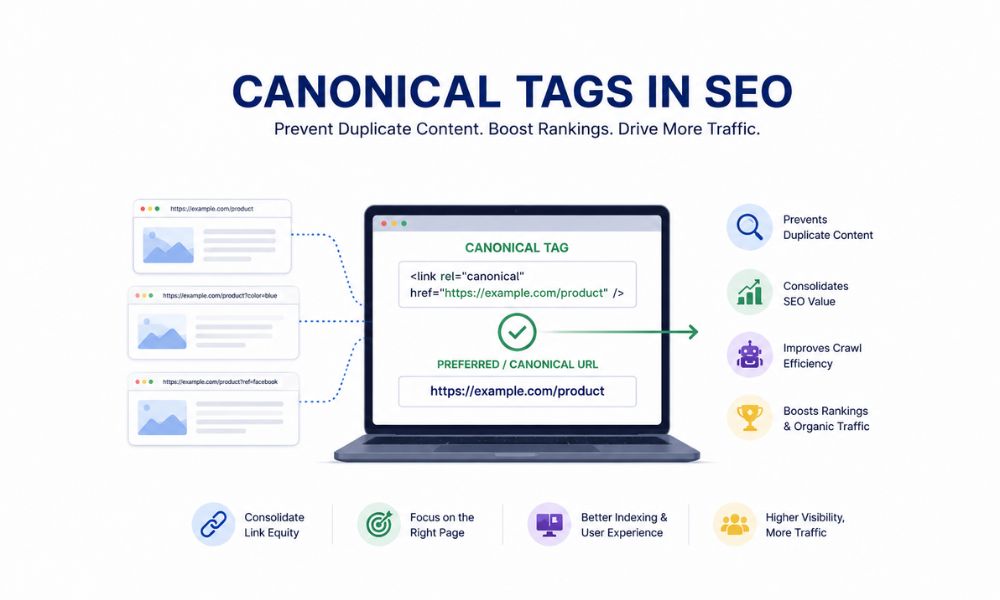
A canonical tag (also called rel=canonical) is an HTML element that tells search engines which URL is the “main” or preferred version of a webpage.
For example, these URLs may show similar content:
- example.com/product
- example.com/product?color=black
- example.com/product?ref=facebook
Without canonical tag, search engines may treat them as separate pages, causing duplicate content issues. A canonical tag tells Google which page should receive the SEO value and ranking authority.
According to Google’s canonical tag guidelines, canonical URLs help search engines identify the preferred version of duplicate pages.
Why Are Canonical Tag Important for SEO?
Canonical tag play a major role in technical SEO and website optimization. They help search engines crawl and index your website more efficiently. Businesses looking to improve technical SEO and website rankings can benefit from professional SEO optimization services offered by Tecklix Technologies.
Prevent Duplicate Content Issues :
Duplicate content can confuse search engines and reduce your ranking potential. Canonical tags clearly identify the original page.
Consolidate SEO Value :
When multiple URLs contain similar content, backlinks and ranking signals may get divided. Canonical tags combine that authority into one main page.
Improve Crawl Efficiency :
Search engines have limited crawl budgets. Canonical tags help Google focus on important pages instead of wasting resources on duplicate URLs.
Enhance User Experience :
A properly optimized website structure improves navigation, indexing, and overall user experience.
When Should You Use Canonical Tags?
Canonical tags are useful in many situations, including:
- E-commerce product variations
- URLs with tracking parameters
- HTTP and HTTPS versions
- WWW and non-WWW versions
- Paginated pages
- Duplicate blog content
- Printer-friendly pages
For example, if your website has multiple product filter URLs, canonical tags ensure that Google indexes only the primary version.
Common Canonical Tag Mistakes :
Many websites use canonical tags incorrectly, which can negatively impact rankings.
Incorrect Canonical URLs :
Always use the correct and live URL in the canonical tag.
Multiple Canonical Tags :
A page should contain only one canonical tag.
Canonicalizing to Unrelated Pages :
The canonical URL should be highly relevant to the page content.
Using Relative URLs :
Always use absolute URLs for better SEO clarity.
Best Practices for Canonical Tags :
To get the best SEO results, follow these proven practices:
- Use self-referencing canonical tags
- Keep internal linking consistent
- Use HTTPS canonical URLs
- Avoid canonical chains
- Regularly audit technical SEO issues
- Ensure canonical pages are indexable
A strong technical SEO foundation helps websites rank higher and generate more organic traffic.
How Canonical Tags Help Increase Website Traffic :
Canonical tags indirectly improve traffic by helping search engines understand your website structure more effectively. When duplicate content issues are resolved, your important pages gain stronger authority and better visibility in search results.
This leads to:
- Higher keyword rankings
- Better indexing
- Increased organic traffic
- Improved click-through rates
- More qualified leads
Businesses that invest in technical SEO often see long-term growth in search engine performance.
Canonical tags are a small but powerful part of SEO. They help search engines identify the original version of your content, reduce duplicate content problems, and improve overall website authority.
If you want your website to rank higher and attract more targeted traffic, implementing canonical tags correctly is essential. At Tecklix Technologies, we specialize in SEO optimization, technical SEO, and digital growth strategies that help businesses achieve better online visibility and generate quality leads.
Whether you run an eCommerce store, corporate website, or business portal, proper canonical tag optimization can significantly improve your SEO performance and search rankings.
Improve Your Website SEO with Tecklix Technologies :
Struggling with low website traffic, poor rankings, or duplicate content issues?
At Tecklix Technologies, we help businesses grow online with advanced SEO strategies, technical optimization, and result-driven digital marketing solutions.
- Technical SEO Optimization
- Website Audit & Performance Improvement
- On-Page & Off-Page SEO
- Google Ranking Improvement
- Lead Generation Strategies
- SEO-Friendly Website Development
Want to improve your website rankings? Contact our SEO experts today for professional guidance.
Whether you want to increase organic traffic, generate more leads, or improve your Google visibility, our SEO experts are ready to help your business grow.
Get in Touch Today :
🚀 Start Growing Your Business with Smart SEO Solutions
Tecklix Technologies — Your Trusted Partner for Digital Growth & SEO Success.
FAQs:
What are canonical tags in SEO and why are they important?
Canonical tags are HTML tags that tell search engines which version of a webpage should be treated as the original page. Canonical tags are important because they prevent duplicate content issues and help consolidate ranking signals into one URL. This improves crawl efficiency, boosts search visibility, and protects your SEO performance. They are especially useful for eCommerce websites, blog categories, and URLs with tracking parameters.
How do canonical tags help improve Google rankings?
Canonical tags help improve Google rankings by combining SEO value from duplicate or similar pages into one preferred URL. This prevents keyword cannibalization and strengthens page authority. Canonical tags also help search engines understand your website structure more clearly, which can improve indexing and organic traffic. Proper technical SEO implementation makes it easier for Google to rank the right page in search results.
When should I use canonical tags on my website?
You should use canonical tags when your website has multiple URLs with similar or duplicate content. Common examples include product filters, pagination, HTTP and HTTPS versions, and URLs with tracking codes. Canonical tags guide search engines toward the main version of the page. This helps maintain SEO authority, improves website indexing, and supports better search engine optimization strategies.
Can canonical tags solve duplicate content issues completely?
Canonical tags can solve many duplicate content issues by telling search engines which page should be indexed as the primary version. However, they are not always a complete solution for every SEO problem. In some cases, redirects or noindex tags may also be required. Using canonical tags correctly alongside technical SEO practices helps improve website authority and search rankings effectively.
What is the difference between a canonical tag and a 301 redirect?
A canonical tag tells search engines which URL is preferred while still allowing users to access multiple page versions. A 301 redirect permanently sends users and search engines to a different URL. Canonical tags are mainly used for duplicate content management, while 301 redirects are used for URL changes and site migrations. Both are important tools in technical SEO optimization.
Do canonical tags affect website traffic and indexing?
Yes, canonical tags can positively affect website traffic and indexing by helping search engines focus on the most important pages. They reduce duplicate indexing problems and consolidate ranking signals into one URL. This improves crawl budget usage and increases the chances of higher rankings in search results. Better indexing often leads to stronger organic traffic and improved SEO performance over time.
Where should canonical tags be placed on a webpage?
Canonical tags should be placed inside the <head> section of a webpage’s HTML code. Search engines read this tag to identify the preferred version of the page. Proper placement ensures that Google and other search engines correctly understand your canonical URL strategy. Accurate implementation is essential for technical SEO, duplicate content management, and maintaining website authority in search rankings.
Can canonical tags hurt SEO if used incorrectly?
Yes, incorrect canonical tags can hurt SEO by sending search engines to the wrong page or creating indexing confusion. Common mistakes include pointing canonical tags to unrelated pages, using broken URLs, or adding multiple canonical tags on one page. These issues may reduce rankings and traffic. Regular SEO audits and technical optimization help ensure canonical tags are implemented properly.
Are self-referencing canonical tags good for SEO?
Yes, self-referencing canonical tags are considered a best practice in SEO. They tell search engines that the current page is the preferred version, even if no duplicate pages exist. Self-referencing canonical tags improve indexing clarity and protect pages from accidental duplicate content problems. Many SEO experts recommend using them as part of a strong technical SEO and website optimization strategy.
How can businesses use canonical tags for better SEO results?
Businesses can use canonical tags to improve search visibility, protect page authority, and reduce duplicate content issues across their websites. Canonical tags are especially useful for eCommerce stores, service pages, and blog content with multiple URL variations. At Tecklix Technologies, businesses can get expert technical SEO solutions that help improve indexing, rankings, and lead generation through smarter website optimization.