



- Written by: jaydeep
- September 14, 2026
- Categories: Local SEO
- Tags: , B2B SEO Services Ahmedabad, Local SEO Company India, On-Page SEO Services Gujarat, Search Engine Optimization Gujarat, SEO, SEO Agency Ahmedabad, SEO Consultant Gujarat, SEO Services, SEO Services Ahmedabad, SEO Services India, Technical SEO Services India, Tecklix Technologies
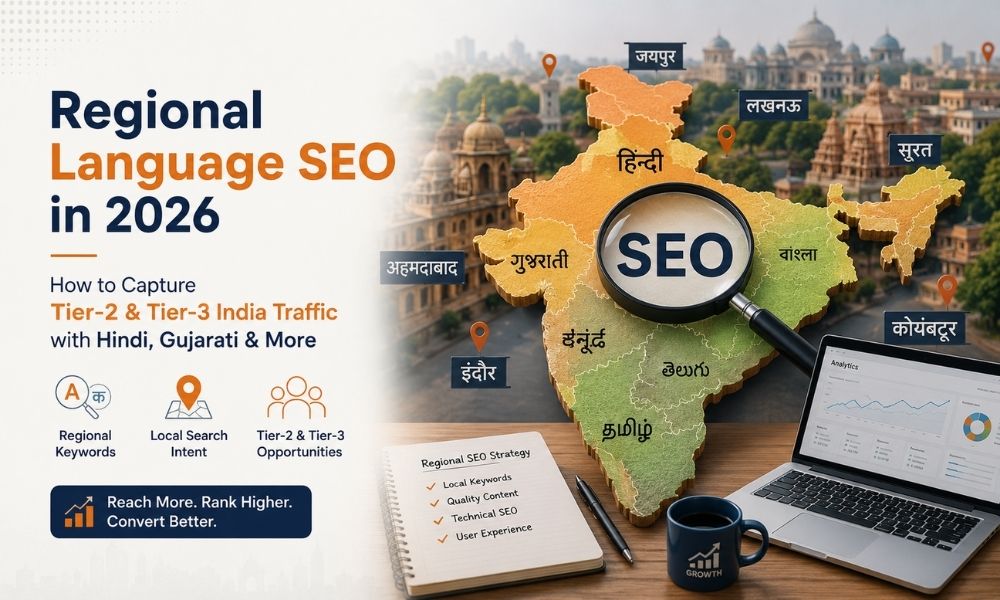
Regional Language SEO in 2026: How to Capture Tier-2 & Tier-3 India Traffic with Hindi, Gujarati & More
India’s search landscape is changing quickly. People in Tier-2 and Tier-3 cities are no longer searching only in English. They use Hindi, Gujarati, Marathi, Bengali, Tamil, Telugu, Kannada, and other regional languages to find products, services, local businesses, and solutions.
For businesses targeting the Indian market, this creates a major SEO opportunity.
Regional language SEO is not simply about translating an English webpage into another language. It is about understanding how people actually search, what words they use, and what information helps them make a decision.
Why Regional Language SEO Matters in 2026:
Search behaviour has become more conversational. Users increasingly type questions the way they speak, particularly when using mobile search and voice assistants.
For example, an English query might be:
“Best digital marketing agency in Ahmedabad”
A Gujarati-speaking user may search using a completely different combination of Gujarati words, English terms, and transliterated phrases. This mixed-language behaviour is common across India.
That means businesses relying only on English keywords can miss valuable search demand.
Google and AI-powered search experiences are also getting better at understanding search intent across languages. A well-structured regional-language page can therefore help a business become visible to users who would never search for the same information in English.
Google’s official guidance for AI features in Search confirms that established SEO fundamentals, crawlable content and unique, helpful information remain important for visibility in generative AI experiences.
For businesses looking to build sustainable organic visibility, a well-planned SEO strategy can help connect regional search demand with relevant products, services and local audiences.
Tier-2 and Tier-3 Cities Are a Major SEO Opportunity:
Cities such as Ahmedabad, Rajkot, Surat, Vadodara, Gandhinagar, Jaipur, Indore, Lucknow, Nagpur, Coimbatore and many other growing urban centres have highly active online audiences.
These users search for everything from digital marketing services and manufacturers to healthcare, education, construction, finance, and local professionals.
The opportunity becomes stronger when businesses combine regional language + local SEO + search intent.
For example, instead of targeting only “SEO company in Ahmedabad,” a business could create useful Gujarati content explaining SEO services, pricing considerations, local search strategies, and common marketing problems in language that its target audience naturally understands.
That creates a much more relevant experience.
Hindi and Gujarati SEO: What Should Businesses Focus On?
The first step is keyword research based on real user behaviour. Do not assume that direct translations are the best keywords.
People frequently use Hinglish, Gujarati-English combinations, and transliterated phrases. Someone may type Gujarati words in English script, while another person may use Gujarati Unicode.
Your SEO strategy should account for both.
Content should also preserve important English industry terminology where users commonly use it. For example, terms such as “SEO,” “digital marketing,” “website,” “Google ranking,” and “social media marketing” are often used naturally within regional-language conversations.
The goal is not to make every sentence purely regional. The goal is to sound natural to the audience. Regional SEO becomes even more effective when it works alongside a broader digital marketing strategy that connects search, content and social channels.
Create Content Around Local Search Intent:
Regional SEO works best when content answers specific questions.
A Gujarati user searching for a digital marketing agency may want to know:
- Which services are included?
- How much does SEO cost?
- How long does SEO take?
- Can a business rank in Google Maps?
- Can SEO generate leads from Ahmedabad or nearby cities?
Instead of creating thin translated pages, businesses should develop genuinely useful content around these questions.
This also supports E-E-A-T, because detailed explanations, practical experience, transparent information, and clear business credentials help demonstrate expertise and trust.
Build a Regional SEO Strategy That Converts:
Traffic alone is not the goal. Qualified leads are.
Every regional-language landing page should have a clear next step. Depending on the business, this could be a quotation request, consultation form, WhatsApp enquiry, phone call, or service page.
Internal linking is equally important. A Gujarati SEO article, for instance, can naturally link to relevant service pages, local SEO content, and case studies. This helps users discover more information while strengthening the website’s topical structure.
At Tecklix Technologies, a practical regional SEO strategy can combine multilingual content, local keyword targeting, technical SEO, Google Business Profile optimisation, content marketing and conversion-focused landing pages.
What Will Regional SEO Look Like Going Forward?
India is not a single-language search market. It is multilingual, mobile-first and increasingly conversational.
Businesses that understand this shift can reach audiences that competitors may overlook. But success will not come from publishing hundreds of translated pages. It will come from creating useful, locally relevant, and naturally written content that matches how people actually search.
In 2026, regional language SEO should be treated as part of a broader Indian SEO strategy—not as an optional add-on.
If your business wants to reach customers across Hindi- and Gujarati-speaking markets, the right combination of regional keywords, local SEO, helpful content, technical optimisation, and strong conversion paths can turn untapped search demand into measurable business opportunities.
As search becomes increasingly conversational, businesses should also understand how AI-powered search and SEO are changing the way users discover information online.
Turn Regional Searches Into Real Leads:
Ready to reach more customers across Hindi, Gujarati, and other regional markets?
Tecklix Technologies can help you build a regional SEO strategy that attracts the right audience and converts search traffic into enquiries.
Target Local. Rank Better. Generate More Leads.
FAQs:
What is regional language SEO, and why is it important in India?
Regional language SEO is the practice of creating and optimising website content for users who search in languages such as Hindi, Gujarati, Marathi, Bengali, Tamil, Telugu and Kannada. It is important because Indian search behaviour is multilingual, with users often combining regional languages, English terms and transliterated phrases. A well-planned regional SEO strategy can help businesses reach audiences in Tier-2 and Tier-3 cities that may be missed by English-only SEO.
Can Hindi and Gujarati SEO help businesses rank in Google in 2026?
Yes. Hindi and Gujarati content can help businesses reach users searching in those languages, provided the content genuinely satisfies their search intent. Google states that its Search systems can understand and match pages to users across different languages. The strongest approach is to create useful, original content rather than simply translating English pages word-for-word.
Should businesses translate their English website into Hindi or Gujarati for SEO?
Translation can be useful, but direct translation alone is not a complete SEO strategy. Regional pages should reflect local vocabulary, search behaviour, terminology and user expectations. Google recommends using separate URLs for different language versions and clearly indicating alternate language versions where appropriate.
Should I target Gujarati keywords in Gujarati script or English transliteration?
Ideally, research and consider both. Indian users may search using Gujarati script, English characters, or a mixture of Gujarati and English terminology. The right choice depends on actual search behaviour rather than assumptions. Instead of forcing keywords into content, businesses should naturally cover the language variations their target audience genuinely uses.
Can regional language content appear in Google AI Overviews?
Regional-language content can be eligible for visibility in Google’s generative AI search experiences when the underlying page is indexed and eligible to appear in Google Search. Google says its AI features rely on Search ranking systems to retrieve relevant information, so strong technical SEO, helpful content, clear information and genuine expertise remain important. However, no SEO technique can guarantee inclusion in an AI Overview.
How can regional language SEO improve leads, not just website traffic?
The key is to connect regional search intent with commercial pages. A useful regional-language blog can answer customer questions and then guide visitors toward relevant services, products, case studies or enquiry pages. Clear calls to action, local business information, trust signals and easy contact options can turn informational traffic into qualified enquiries.
Does Google require special AEO or GEO techniques for regional language SEO?
No. Google’s 2026 guidance says website owners should continue applying established SEO fundamentals rather than relying on special AEO or GEO hacks. Google specifically recommends unique, valuable, people-first content, strong technical foundations and content that genuinely helps users.
How does E-E-A-T improve regional SEO performance?
E-E-A-T can be strengthened by demonstrating real expertise and experience through accurate information, practical examples, transparent business details, qualified authorship where relevant, trustworthy references and clear explanations. For regional audiences, local knowledge can make content even more useful because it connects general information with the problems customers actually face.
Should every business create separate Hindi, Gujarati and English pages?
Not necessarily. Businesses should prioritise languages and locations where there is meaningful audience demand. Creating dozens of low-value translated pages can create unnecessary complexity and may provide little benefit. A smaller number of genuinely useful, well-localised pages is usually a stronger strategy than publishing large volumes of near-duplicate content.
What is the best regional SEO strategy for Tier-2 and Tier-3 cities in India in 2026?
A strong strategy combines regional keyword research, useful localised content, technical SEO, separate language URLs where appropriate, local SEO, internal linking, trustworthy business information and conversion-focused landing pages. Most importantly, the content should be created for real users first. Google’s current guidance emphasises unique, valuable and reliable content as a foundation for both traditional Search and generative AI experiences.