



- Written by: jaydeep
- September 1, 2026
- Categories: Artificial Intelligence
- Tags: , AI, AI Automation Solutions India, AI Chatbot Development Gujarat, AI for Business India, AI for Manufacturing Industry, AI Marketing Tools Ahmedabad, AI Services Ahmedabad, Artificial Intelligence Solutions Gujarat, Tecklix Technologies
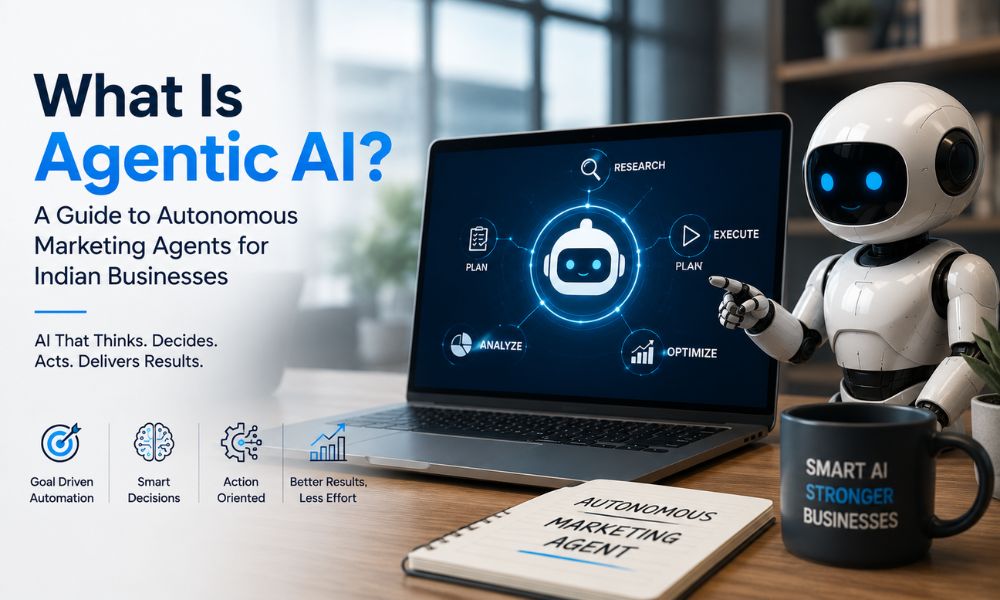
What Is Agentic AI? A Guide to Autonomous Marketing Agents for Indian Businesses
Artificial intelligence has moved far beyond chatbots that simply answer questions. A newer shift is taking place now: Agentic AI. Instead of waiting for a human to give instructions at every step, agentic AI systems can understand a goal, make decisions, use connected tools, complete tasks, and adjust their actions based on results.
For Indian businesses, this can change how digital marketing is planned and executed. From lead generation and customer follow-ups to SEO research and campaign optimization, autonomous marketing agents can help teams handle repetitive work while spending more time on strategy, creativity, and customer relationships.
But what exactly is Agentic AI, and where does it fit into a practical marketing strategy?
What Is Agentic AI?
Agentic AI refers to AI systems designed to work toward a defined objective with a degree of autonomy. Unlike a traditional AI tool that responds to a single prompt, an AI agent can break a larger goal into smaller actions, execute those actions using available tools, evaluate the results, and decide what to do next.
For example, a conventional AI tool may generate a social media caption when asked.
An agentic marketing system could go much further. It might identify a target audience, research relevant topics, create campaign ideas, schedule content, monitor engagement, identify underperforming posts, and recommend changes.
The key difference is not simply “AI can do more.” It is that the system is designed around goals, decisions, actions, and feedback.
How Do Autonomous Marketing Agents Work?
An autonomous marketing agent generally follows a cycle:
Goal → Research → Decision → Action → Measurement → Adjustment
Suppose an Indian B2B company wants to generate more qualified leads for a particular product.
An AI marketing agent could research search trends, examine existing website content, identify content gaps, suggest topics based on customer intent, prepare content briefs, monitor organic performance, and flag opportunities for improvement.
Some systems can also connect with CRM platforms, analytics tools, advertising platforms, email systems, or content management software. This allows the agent to work with real business data rather than operating only from a text prompt.
Human oversight still matters. The most useful approach is not to remove people from marketing, but to let AI handle repetitive processes while experienced marketers remain responsible for positioning, approvals, brand voice, budgets, and important decisions.
Agentic AI vs Traditional AI: What Is the Difference?
The distinction becomes clearer with a simple example.
Imagine you ask an AI tool:
“Write five blog ideas for an Indian manufacturing company.”
A traditional generative AI system may provide five ideas.
An agentic AI workflow could take the objective further. It might research customer search intent, review existing pages, identify content gaps, prioritize keywords, create a content plan, and track which topics perform better over time.
Traditional AI is often prompt-driven.
Agentic AI is more goal-driven.
That does not mean every AI agent is completely autonomous. The level of independence depends on its design, permissions, connected tools, and business rules.
Where Can Indian Businesses Use Agentic AI in Marketing?
India has a diverse digital market, with businesses ranging from local service providers and D2C brands to SaaS companies, manufacturers, exporters, and professional service firms. Their marketing requirements are different, but many workflows contain repetitive tasks that agents can support.
Agentic AI works best when it is connected to a broader digital marketing strategy that brings SEO, content, social media, paid campaigns, and customer journeys together.
1. SEO and Content Research
Marketing agents can assist with keyword research, search intent analysis, competitor content comparison, topic clustering, content briefs, internal-linking opportunities, and performance monitoring.
For businesses targeting competitive Indian search results, this can make content planning more systematic.
The goal should not be producing hundreds of AI-written pages. It should be creating useful, experience-led content that genuinely answers customer questions. For businesses that want to turn this research into sustainable organic visibility, a structured SEO strategy for Indian businesses can help connect search intent with useful, experience-led content.
2. Lead Generation
An agent can monitor incoming enquiries, categorize leads, identify high-intent prospects, and trigger appropriate follow-up workflows.
For example, a website visitor asking about industrial equipment may require a very different response from someone requesting a general product brochure. AI can help classify these enquiries before a sales representative takes over.
3. Customer Follow-Ups
Missed follow-ups can quietly cost businesses revenue.
Agentic workflows can help remind sales teams about pending enquiries, initiate approved email sequences, summarize previous conversations, or identify prospects who have become inactive.
For Indian businesses handling a high volume of WhatsApp, website, email, and CRM enquiries, this type of automation can reduce manual workload.
4. Paid Advertising
AI agents can assist with campaign monitoring by identifying unusual changes in cost per lead, click-through rate, conversion rates, or other performance indicators.
Rather than checking dashboards manually every few hours, marketing teams can receive prioritized insights and recommendations.
Any automated campaign changes should still operate within clearly defined budgets and approval rules.
Why Agentic AI Matters for Small and Mid-Sized Businesses:
Large companies have traditionally had access to dedicated marketing teams, analysts, automation specialists, and expensive software stacks.
Agentic AI can narrow part of that gap.
A growing Indian business may not need separate people manually performing every research, reporting, monitoring, and follow-up task. With the right systems, a small team can potentially manage a much broader marketing operation.
That does not mean replacing marketers.
It means giving marketers more leverage.
A business owner can spend less time compiling reports and more time understanding customers. A content strategist can spend less time collecting data and more time developing useful ideas. A sales team can spend less time sorting enquiries and more time speaking with serious prospects.
Businesses can start small by identifying repetitive workflows that are suitable for AI automation services, then gradually connect more marketing and sales processes as the system proves its value.
Is Agentic AI Fully Autonomous?
Not necessarily—and businesses should be careful with that assumption.
Marketing involves brand reputation, customer data, advertising budgets, compliance requirements, and commercial decisions. Giving an AI system unlimited access without safeguards can create unnecessary risks.
A responsible implementation should define:
- What the agent is allowed to do
- Which actions require human approval
- What data it can access
- Which tools it can use
- Spending and operational limits
- How actions are logged and reviewed
- What happens when the system is uncertain
The strongest model is usually human-in-the-loop AI, where autonomous systems handle routine execution while people retain control over sensitive or strategic decisions.
How Indian Businesses Can Start With Agentic AI:
There is no need to automate an entire marketing department on day one.
Start with one measurable problem.
Perhaps your sales team spends too much time qualifying enquiries. Maybe SEO reporting takes hours every week. Or your marketing team struggles to maintain consistent follow-ups.
Map that workflow first. Identify where decisions are repetitive, where information is available digitally, and where an AI agent could safely take action.
Then measure the outcome.
Look at metrics such as qualified leads, response time, conversion rate, marketing hours saved, cost per acquisition, and revenue generated—not simply the number of automated tasks completed.
The Future of AI-Powered Marketing in India:
Agentic AI is moving marketing from “AI that creates” toward “AI that acts.”
That shift is significant.
The businesses that benefit most will not necessarily be those using the largest number of AI tools. They will be the ones that connect AI with clear business objectives, reliable data, strong processes, and human expertise.
For Indian businesses, the opportunity is particularly interesting. A well-designed autonomous marketing workflow can help a lean team research faster, respond quicker, personalize customer journeys, and make better use of marketing data.
At Tecklix Technologies, we believe AI automation should solve real business problems rather than become another technology trend added to the software stack. Whether the objective is improving SEO workflows, automating lead management, strengthening digital marketing operations, or building smarter customer journeys, the starting point should always be the same: understand the business goal first, then decide where AI can create measurable value.
Agentic AI is not about handing your entire marketing operation to a machine. It is about building a smarter system where people and AI each do what they are best at.
For businesses ready to explore that model, the next step is simple: identify one repetitive marketing process, define the desired outcome, and test automation against a real business metric. India’s growing AI ecosystem also makes responsible and practical AI adoption increasingly relevant for businesses, with the IndiaAI Mission focusing on areas such as AI infrastructure, innovation, datasets, skills, and responsible AI development.
Ready to Make Your Marketing Smarter with Agentic AI?
Turn repetitive marketing tasks into intelligent, automated workflows. Tecklix Technologies helps Indian businesses use AI, automation, SEO, and digital marketing to generate better leads and improve marketing efficiency.
Ready to explore what AI can automate for your business? Get in touch with Tecklix Technologies today.
FAQs:
What is Agentic AI in marketing?
Agentic AI in marketing refers to AI systems that can work toward a defined marketing goal by researching information, making decisions, using connected tools, taking actions, and evaluating results. Unlike a basic chatbot that responds to individual prompts, an AI marketing agent can manage multi-step workflows with limited human intervention.
For businesses, this can include SEO research, lead qualification, campaign monitoring, customer follow-ups, content planning, and marketing performance analysis.
How is Agentic AI different from generative AI?
Generative AI primarily creates content such as text, images, summaries, or ideas when a user provides a prompt. Agentic AI goes a step further by acting toward a goal.
For example, generative AI can write a social media post. An autonomous marketing agent may research the topic, create the post, schedule it through an approved platform, monitor performance, and recommend improvements based on the results.
The difference is essentially content generation versus goal-oriented action.
Can Indian businesses use autonomous AI marketing agents?
Yes. Indian businesses across manufacturing, e-commerce, SaaS, professional services, healthcare, education, real estate, and local services can use autonomous marketing agents for suitable workflows.
The practical opportunity is often greatest in repetitive processes such as lead qualification, SEO research, reporting, customer follow-ups, campaign monitoring, and content planning. However, businesses should establish clear permissions and human approval for sensitive decisions involving budgets, customer data, brand reputation, or compliance.
Can Agentic AI help generate more leads?
Agentic AI can support lead generation, but it cannot guarantee a specific number of leads or conversions.
An AI agent can help identify high-intent prospects, analyze website enquiries, qualify leads, personalize approved follow-ups, monitor campaign performance, and identify potential opportunities.
The actual results depend on factors such as the quality of the offer, website experience, audience targeting, sales process, market demand, and conversion strategy. For this reason, Agentic AI should be measured using meaningful business metrics such as qualified leads, conversion rate, response time, and cost per acquisition.
How can Agentic AI improve SEO for Indian businesses?
Agentic AI can support SEO by helping with keyword research, search-intent analysis, content-gap identification, topic clustering, internal-linking opportunities, competitor research, content briefs, and performance monitoring.
However, AI automation should not become a reason to publish large volumes of low-value content. Google’s current guidance emphasizes creating useful, original, people-first content rather than producing pages simply to manipulate Search or AI-generated results.
For Indian businesses, the strongest approach is to combine AI-assisted research with genuine industry knowledge, first-hand experience, expert review, and accurate information.
Can Agentic AI content rank in Google AI Overviews?
AI-generated or AI-assisted content can appear in Search when it meets Google’s quality and Search requirements, but there is no guaranteed method for making a page appear in an AI Overview.
Google’s current guidance says the same SEO fundamentals that help websites perform in traditional Search remain relevant to generative AI experiences such as AI Overviews and AI Mode.
Google also emphasizes useful, unique, non-commodity content and strong technical accessibility.
The practical goal should therefore be to create content that deserves to be cited—not content written solely to manipulate an AI answer. Businesses can also review Google’s official guidance on optimizing websites for generative AI features in Search to understand what actually matters for visibility in AI Overviews and AI Mode.
Is Agentic AI safe for business marketing?
Agentic AI can be used safely when businesses control its permissions, data access, tools, budgets, and approval process.
A responsible implementation should define what an AI agent can access, which actions it can perform automatically, which actions require human approval, and how activities are monitored.
For example, an agent may automatically categorize website enquiries but require a salesperson to approve an important customer communication. This human-in-the-loop approach helps balance automation with accountability.
What marketing tasks should businesses automate with Agentic AI?
The best tasks to automate are usually repetitive, rule-based, measurable, and supported by reliable data.
Examples include lead categorization, marketing reports, SEO research, campaign monitoring, follow-up reminders, content briefs, customer enquiry routing, and performance alerts.
Strategic decisions such as brand positioning, major advertising budgets, sensitive customer communication, and high-impact business decisions should generally retain human oversight.
Does Agentic AI replace digital marketing agencies and marketers?
Not necessarily. Agentic AI is better viewed as a productivity and decision-support layer rather than a complete replacement for marketing expertise.
AI can process information quickly and handle repetitive workflows, while experienced marketers provide strategy, creativity, market understanding, brand judgment, and accountability.
For an Indian business, the strongest model can be a combination of AI automation + experienced marketing professionals + reliable business data.
How should an Indian business start using Agentic AI for marketing?
Start with one clearly defined business problem rather than attempting to automate the entire marketing operation.
For example, a company could begin by automating lead qualification, SEO reporting, customer follow-ups, or campaign monitoring. Define the expected outcome, connect only the necessary tools and data, establish human approval rules, and measure the results.
A professional AI and digital marketing strategy should focus on measurable outcomes such as better-qualified leads, faster response times, improved marketing efficiency, stronger customer journeys, and sustainable organic visibility rather than simply increasing the number of automated tasks.