



- Written by: jaydeep
- August 16, 2026
- Categories: Digital Marketing
- Tags: , Content Marketing India, Digital Marketing, Digital Marketing Agency India, Digital Marketing Ahmedabad, Digital Marketing for B2B Manufacturers, Local SEO Services Ahmedabad, Online Marketing Services Ahmedabad, PPC Services Gujarat, SEO Services Gujarat, Social Media Marketing Ahmedabad, Tecklix Technologies
For a small business, having a good product or service is only part of the growth equation. Customers also need to find the business, understand what it offers, trust it, and have an easy way to make an enquiry or purchase. This is where digital marketing becomes important.
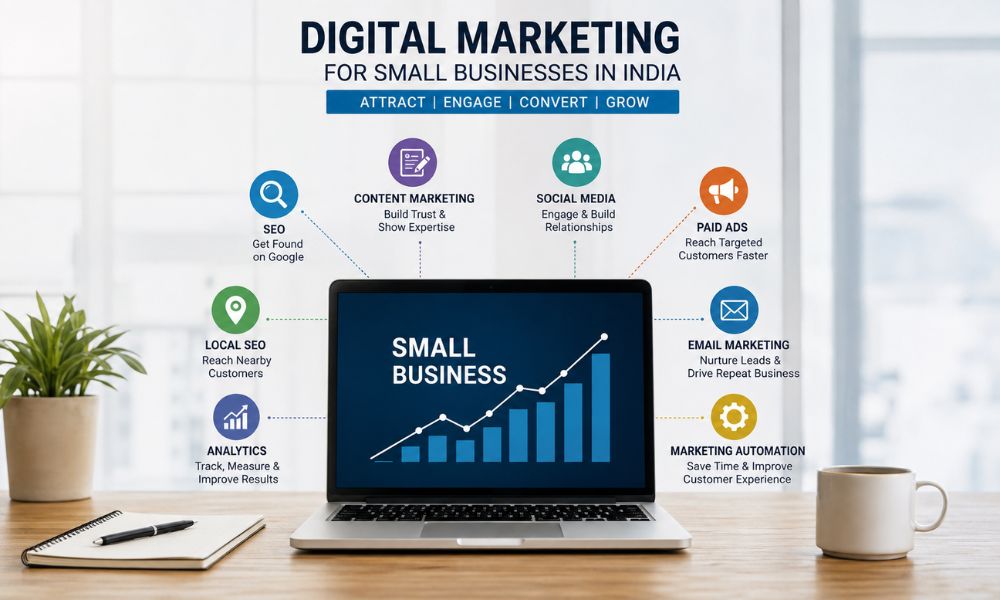
Digital Marketing allows small businesses to reach potential customers through search engines, websites, social media, online advertising, email, and other digital channels. The advantage is that businesses can start with focused campaigns, measure results, and improve their approach based on real customer behavior.
What Is Digital Marketing?
Digital marketing is the use of online channels and digital technologies to promote a business, connect with customers, generate enquiries, and support sales.
It can include:
- Search engine optimization (SEO)
- Website development and conversion optimization
- Social media marketing
- Paid advertising
- Content marketing
- Email marketing
- Local SEO
- Analytics and performance tracking
- Marketing automation
The right combination depends on the business, target audience, location, industry, budget, and marketing goals.
Why Is Digital Marketing Important for Small Businesses?
Traditional advertising can make it difficult to understand exactly how people interact with an advertisement. Digital marketing provides more measurable information.
A business can track metrics such as website visits, search visibility, enquiries, advertising clicks, conversion rates, and customer interactions.
This allows business owners to ask better questions:
Which channel is bringing visitors? Are those visitors relevant? Are they becoming leads? Which campaigns are producing actual business results?
The answers can help companies spend their marketing budget more effectively.
1. Build a Strong Website First
A website is often the foundation of a company’s digital presence.
A good business website should clearly explain what the company offers, who it serves, why customers should trust it, and how visitors can take the next step.
Important elements include:
- Clear service or product information
- Simple navigation
- Mobile-friendly design
- Fast and accessible pages
- Strong calls to action
- Contact and enquiry options
- Trust signals and business information
- Useful, original content
A beautiful website that does not make it easy for visitors to understand the offer or contact the business may generate traffic without generating enough enquiries.
2. Use SEO to Build Long-Term Visibility
Search Engine Optimization helps businesses improve their visibility when potential customers search for relevant products, services, or information.
For example, a local service business may target searches related to its services and location, while an e-commerce business may focus on product and category searches.
Effective SEO involves more than adding keywords to pages. Businesses should focus on search intent, useful content, technical accessibility, internal linking, page experience, and trustworthy information.
For long-term growth, businesses should aim to create content that genuinely answers customer questions rather than publishing articles only because a keyword has search volume.
3. Use Local SEO to Reach Nearby Customers
For businesses serving specific cities or regions, local SEO can be particularly valuable.
A business should maintain accurate information across its online presence, create useful location-relevant content where appropriate, and build a trustworthy local presence.
Google Business Profile can also help eligible businesses appear in relevant local Search and Maps results.
For example, a service provider targeting Ahmedabad should make it clear which services it provides and which areas it serves without creating repetitive, low-value location pages. Businesses should follow Google Search Essentials when building their SEO foundation.
4. Social Media Builds Visibility and Relationships
Social media marketing can help businesses demonstrate their expertise, showcase products, answer customer questions, and build familiarity with their brand.
The best strategy is not necessarily to post every day. Consistency and relevance matter more than simply increasing the number of posts.
Businesses can create different types of content, such as:
- Educational posts
- Product demonstrations
- Customer stories
- Behind-the-scenes content
- Industry insights
- FAQs
- Short-form videos
- Practical tips
Social media should support broader business objectives rather than operate as a completely separate marketing activity.
5. Paid Advertising Can Accelerate Reach
SEO can take time to build, while paid campaigns can help businesses reach targeted audiences more quickly.
Platforms such as Google Ads and social advertising platforms allow businesses to target specific audiences, keywords, locations, interests, or customer behaviors depending on the campaign type.
However, spending money on advertisements does not automatically create profitable growth.
Businesses should monitor:
- Cost per lead
- Conversion rate
- Lead quality
- Customer acquisition cost
- Revenue generated
- Return on advertising spend
A campaign that generates many clicks but few qualified enquiries may need a different targeting, offer, landing page, or conversion strategy.
6. Content Marketing Builds Trust
People often research before contacting a business.
They may search for pricing information, comparisons, how-to guides, product specifications, common problems, or expert recommendations.
Useful content can help a business answer these questions before the customer makes contact.
High-quality content should demonstrate genuine knowledge, provide accurate information, and offer something useful to the reader. Businesses can strengthen trust by showing relevant experience, clear authorship, original examples, and transparent information.
7. Track the Complete Customer Journey
Traffic alone is not the final objective.
A business should understand what happens after someone visits the website.
For example:
Search → Website → Service Page → Enquiry → Sales Follow-Up → Customer
Analytics and conversion tracking can help identify where potential customers are dropping out.
This is important because a website receiving thousands of visitors may still generate fewer customers than a smaller website attracting highly relevant visitors.
How Should a Small Business Start Digital Marketing?
Businesses do not need to invest in every channel at once.
A practical starting point is:
- Define the target customer.
- Set a measurable business goal.
- Build or improve the website.
- Establish the right SEO foundation.
- Create useful content.
- Build a consistent social media presence.
- Test paid advertising when appropriate.
- Track enquiries and conversions.
- Review performance regularly.
- Invest more in channels that produce meaningful business results.
The strategy should evolve based on data and customer feedback rather than following every new marketing trend.
Final Thoughts:
Digital marketing is not a single service or one-time activity. It is a combination of channels and processes that work together to attract, educate, convert, and retain customers.
For small businesses in India, the most effective strategy is usually the one that matches the company’s audience, location, budget, and growth objectives.
A strong website, useful content, SEO, social media, paid campaigns, analytics, and consistent customer communication can create a solid digital foundation.
The goal should not simply be more traffic. The real goal is more relevant traffic, better enquiries, stronger customer trust, and sustainable business growth.
Ready to Grow Your Business Online?
Turn clicks into customers with a smarter digital marketing strategy.
Tecklix Technologies helps businesses grow through SEO, Web Development, Social Media Marketing, Paid Campaigns & AI Automation.
FAQs:
What is digital marketing for small businesses?
Digital marketing is the use of online channels such as search engines, websites, social media, paid advertising, email, and online platforms to attract customers and grow a business. For small businesses, digital marketing can help build visibility, generate relevant enquiries, communicate with customers, and measure marketing performance more effectively.
How can digital marketing help a small business get more customers?
Digital marketing can help businesses reach people who are actively searching for their products or services, discover new audiences, and build trust before a customer makes an enquiry. A combination of SEO, a conversion-focused website, social media, content, and paid advertising can create multiple opportunities for potential customers to find and contact a business.
Which digital marketing strategy is best for small businesses in India?
There is no single strategy that works for every business. The right approach depends on the industry, target audience, location, competition, budget, and business objectives. Many small businesses can start with a strong website, local SEO, useful content, social media, and targeted advertising, then expand based on measurable results.
Is SEO better than paid advertising for small businesses?
SEO and paid advertising serve different purposes. SEO can help build sustainable organic visibility over time, while paid advertising can provide faster exposure for targeted searches and audiences. Instead of choosing one universally, businesses should evaluate both based on lead quality, customer acquisition cost, competition, timeline, and long-term growth objectives.
How important is a website for digital marketing?
A website is often the central destination for digital marketing traffic. It should clearly explain the business, services or products, demonstrate credibility, provide useful information, and make it easy for visitors to contact the company. A technically accessible, mobile-friendly, trustworthy website can support SEO, social media, paid campaigns, and conversion efforts.
How does local SEO help small businesses in India?
Local SEO helps businesses become more discoverable for relevant searches associated with their services and locations. Maintaining accurate business information, creating useful location-relevant content, building a trustworthy online presence, and optimizing an eligible Google Business Profile can help local customers find and evaluate a business.
How much should a small business spend on digital marketing?
There is no universal digital marketing budget. A practical budget depends on the business’s revenue goals, competition, target market, customer acquisition cost, and available resources. Businesses should start with measurable objectives and evaluate results such as qualified leads, conversions, customer acquisition cost, and revenue rather than judging success only by traffic or clicks.
How can small businesses measure whether digital marketing is working?
Businesses should connect marketing activity with meaningful outcomes. Important measurements can include qualified leads, conversion rate, cost per lead, customer acquisition cost, organic search visibility, website engagement, and revenue generated. Tracking the customer journey from marketing channel to enquiry and sale provides a more useful picture than measuring website traffic alone.
How can businesses create trustworthy digital marketing content?
Trustworthy content should provide accurate, useful, and original information while demonstrating relevant experience and expertise. Businesses can strengthen credibility through clear authorship, first-hand insights, reliable sources, practical examples, transparent business information, and appropriate fact-checking. Google recommends creating helpful, reliable, people-first content rather than content primarily designed to manipulate search rankings.
Can AI be used in digital marketing without hurting SEO?
Yes, AI can assist with tasks such as research, data analysis, content planning, and marketing workflows, but businesses should focus on the quality and usefulness of the final content. AI-generated or AI-assisted content should be reviewed for accuracy and enhanced with genuine expertise, original insights, and useful information. Google states that generative AI can be useful when it helps create helpful content, while producing large amounts of low-value content primarily to manipulate rankings can violate its spam policies.